By Kennedy Batchelder
To become a coach at the collegiate level it takes a lot of work. It’s more than just walking onto the field, court, pitch, etc. and just blowing a whistle and yelling at people. It takes research and understanding on why certain things work over others, and how to keep your players healthy and on track of their schooling. But coaches also must understand how difficult it is to be a student athlete. But 9 times out of 10 they do know what it’s like because they once were a collegiate student athlete themselves at one point or another. That is exactly the case with Coach Jerimiah Fiscus and Mitch Leppke. Both are McPherson College alumni, and both were a part of the football team. They now coach together as head coach and defensive coordinator here at McPherson College.
Fiscus was a junior college transfer from Dodge City Community College and when asked what made him choose to go to McPherson College, he had this to say, “It was down to Ottawa and Mcpherson and I had three former teammates from Dodge City here with another guy coming here and ultimately I was probably going to Ottawa, but the coach that I was going to be playing for… got out of coaching in that cycle.” “I just felt a stronger connection at McPherson College…Dave Barrett, who works in advancement, he was in admissions at the time, and he gave me my tour and had a good tour and had a good connection with the guy that was recruiting me here and ultimately chose to come here.” Through the years Fiscus has been here he feels, “That the two things that separate us the most are the opportunity for students to build interpersonal relationships…and the career service-oriented education…that the college wants to build students that get jobs.”
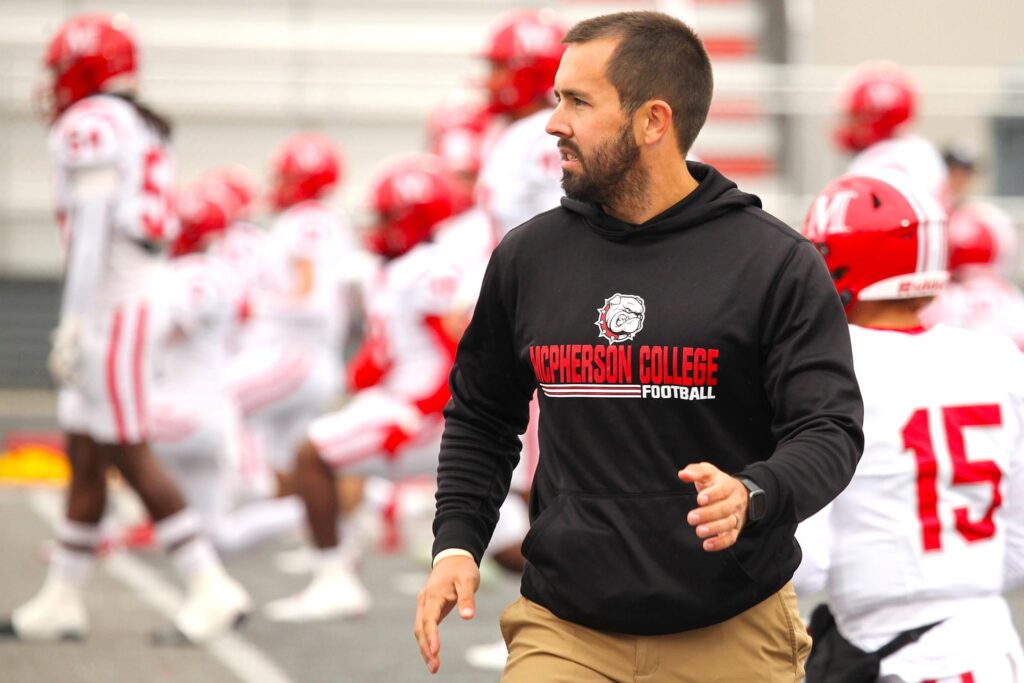
The student aspect plays a big part in coaching. College coaches are expected to have at least a bachelor’s degree in any subject but most usually pick Sports management, Athletic training, Kinesiology, Physical education, sports medicine, and Marketing. They too know the struggles of balancing school, sports and life. But not every coach’s story is the same. Becoming is coach is hard, there are many steps that go into the process of becoming one. Coach Leppke started his academic career as a history education major and later changed his major to physical education with a minor in sports management and later got his master’s in communications. Leppke says he loved his time here at McPherson College as a student athlete and if it wasn’t for being a student athlete he “wouldn’t be coaching, wouldn’t want to keep being around football, and wouldn’t have wanted to come back to McPherson College.” College athletics lead coach Leppke to his career. “It just happens to be in college athletics.” Like student athletes now, Leppke liked to play video games, hang out with his teammates, and surround himself around football as much as possible. Some may “…say too much football.”
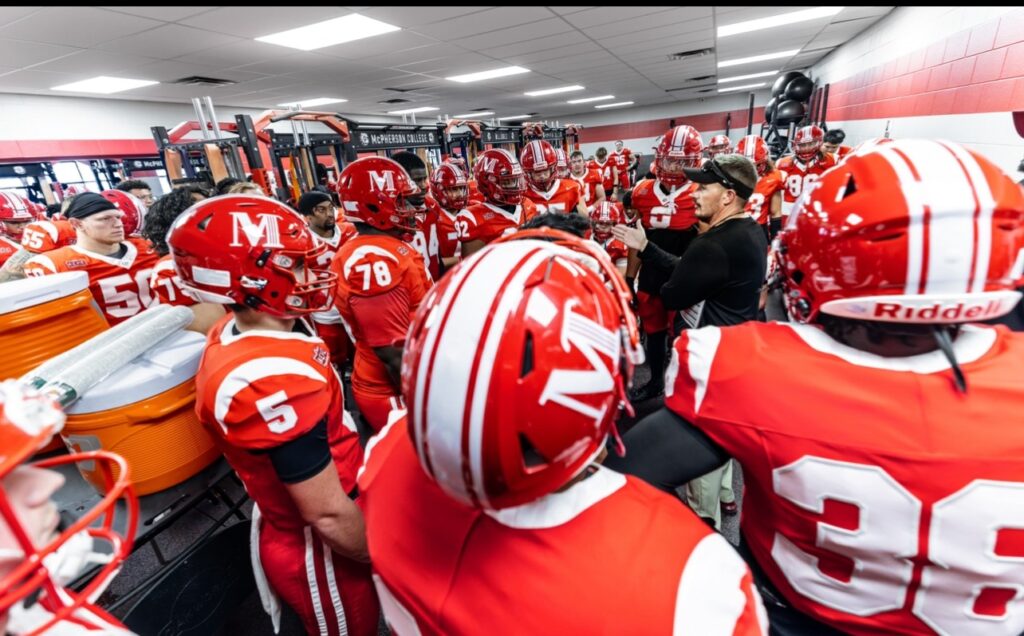
Both coaches have a long list of work experience when it comes to coaching. Coach Leppke coached at Qunicy University from 2014-2016 as a defensive backs coach/graduate assistant, Minnesota State University Moorhead from 2016-2017 as a safety coach, university of Wyoming from 2017-2018 as defensive quality control, and went back to Quincy University from 2018-2021 as the safeties and defensive backs coach, Missouri Southern State University from 2021-2023 as the defensive backs coach, and finally coach Leppke made it back home to McPherson College as the current defensive coordinator.
Coach Fiscus started his coaching career at Northwestern State University as an offensive graduate assistant and running backs coach from 2008-2010, then went on to coach at, Texas Christian University from 2010-2012 as a graduate assistant, Henderson State University from 2012-2018 as the offensive coordinator, recruiting coordinator, and offensive line coach. After that he became a high school head coach at Bluestem Junior, Senior High School for a year in 2018 before the opportunity arose to come home to McPherson College where he is currently the head coach and offensive line coach.
McPherson is known to be a very family-friendly area to live in. I asked each coach one final question and that was, “Do you feel that coming back to McPherson College was the right choice for you and your family.” Leppke felt that moving back to McPherson College was a win for both him and his family. He gets to call plays and build a defensive, which he has “been trying to do for a long, long time.” Quality of life was super important to him because of his young children he is raising with his wife and being at McPherson College allows him to be around them as much as possible. Fiscus had a similar take on the question. He felt that being at McPherson College allows him “to give a lot of young people opportunities and help them grow up and hopefully find a path for themselves.” And he felt like the town of McPherson was very “organic like”, he was able to get daycare for his kids within two phone calls and his wife was able to easily find a job in her career field. Everything just sat right in line for the coaches, and they couldn’t be any happier. Well, that’s until they win a KCAC championship.
Leave a Reply